A human was here.
Writing in the age of AI
The evolution of language is a fascinating subject, if you’re that way inclined. Did you know that there’s a hill in England that is essentially called hill hill hill hill, because the invaders didn’t understand its previous name, and simply renamed it in their own language, each time meaning…hill?
But what relevance has this got to you, sitting here on a gloomy Tuesday afternoon in 2026, reading this as a means to avoid your inbox? A lot more than you might think, actually.
You see, we are currently in the midst of a major language shift. Writing in the age of AI, the way that we express ourselves is changing at a rate that far outpaces the slow, organic revisions that language evolution is known for.
Capital letters are being quietly abandoned (Gen Z, I see you). The em dash – once the darling of the internet essay – is currently on life support, due to its overuse by AI. And beneath all of the chaos is the low hum of what can only be described as perfection fatigue.
It’s the same impulse that sends us back to vinyl records, analogue cameras and endlessly rewatching The Godfather for their lack of convenience, their tactile clunkiness, the slowness and the humanity that they represent. Smoothness has become suspect; polish feels impersonal. Yes, it is a little bit of nostalgia, sure – but with the world of 2026 already stressing us out, who can blame us?
Language evolution and perfection fatigue
Language has always been an ever-evolving entity, prone to fads and resurgences, shifts in meaning and colourful slang. Gay is, of course, the most often cited change of meaning, whether pejoratively or for empowerment. But this moment feels different.
AI is changing how we write. And by that I don’t mean using it to research topics more quickly; or prompting, copying and pasting a complete article that is, in effect, AI slop. No, I mean the physical sentence structures. The tone and flow and word choices we opt for. The way we communicate is being fundamentally altered.
Robotic writing and the problem with polish
AI-generated text is being applauded by some, despised by others, and used for every aspect of their written world by a third group. If your world falls somewhat outside of its remit, then your thoughts on it might be little more than a shrug.
But writing in the age of AI, aided by AI, is a strange beast. It is, at least on the surface, wildly impressive. Grammatically sound, neatly structured, relentlessly polite.
And yet.
There is something deeply tiring about the blandness of it all, the predictable ‘its not just a, but b’ formatting, the emotional sterility of stating the facts in a faux positive chatter. And there is a calmness and coldness to the way it functions that feels somehow empty. It’s saying all the right things, and somehow saying nothing at all.
This in itself poses a question that all grammar nerds have hidden behind for centuries: Is well-written text enough to satisfy readers? Some people certainly believe so: as of late 2024–2025, over 50% of newly published English language articles online were found to contain AI-generated or AI-assisted text.
AI-generated content is still being used every day, in spite of the many controversies surrounding it, and unfortunately AI-generated text is everywhere. But for us humans, trying to connect with other humans (and put our brand in the most positive light), this could present an opportunity to stand out and offer something deeper.
Whether that represents a stand against AI altogether, or placing humans at the forefront of AI collaboration, remains to be decided. AI is not inherently evil, but it is up to us to use it responsibly, if we choose to use it at all.
And there is the rub: a lot of us are using it, but seem embarrassed to admit it. We try to make it sound more human, which in itself can be more work than just writing things ourselves. Plus, there are fears for future penalties against using it, even if it does perform better than human created text. The jury is still out on both of those topics.
In defence of awkward sentences
In response to this glut of robotic writing, we are seeing a quiet return of the ungainly sentence. The awkward sentences we once edited out but now choose to keep; the meandering, adjective-heavy verbosity that serves as a backlash against the short, efficient summaries that AI churns out. Details matter, as if humanity can be found hidden among the specifics of what is being described.
Uncertainty, perhaps consciously so, has become a style within itself. Look, I err; therefore I am real. The repetitions or contractions, or the loss of purpose mid-paragraph are more common than in the pre-ChatGPT era, left in as evidence of consciousness. This messiness is a human fingerprint; an acknowledgment that we, as people, understand that thoughts are not linear, and speaking with vulnerability is something that a computer would never do without prompting.
Just as early humans left marks on walls and teenagers deface desks, so too is this need to inject humanity into what we write, even if it is for a fleeting social media post or a half-read blog post.
A human was here.
But is this merely an aesthetic choice? For the younger internet generation, using properly structured sentences is cringe anyway (who wants to sound like a bot, after all?) Or is it something closer to a moral obligation that a lot of us are feeling, to show that we are still here, that we are not cowering to our AI overlords (or their billionaire masters) and that we care deeply about the ramifications of what could come next if we did? That we understand, instinctively, that there are real consequences to what we do?
The search for authenticity in writing
Searches for ‘is this AI?’ have exploded. Even the act of detecting machine-written content has itself been outsourced to algorithms, which some are eager to trust implicitly. Authenticity in writing is becoming harder to come across, but we recognise immediately when it isn’t there.
At the same time, literacy seems to be falling. Studies are now beginning to suggest that most readers cannot reliably tell AI-generated text from human writing, even as overall trust in online content continues to decline.
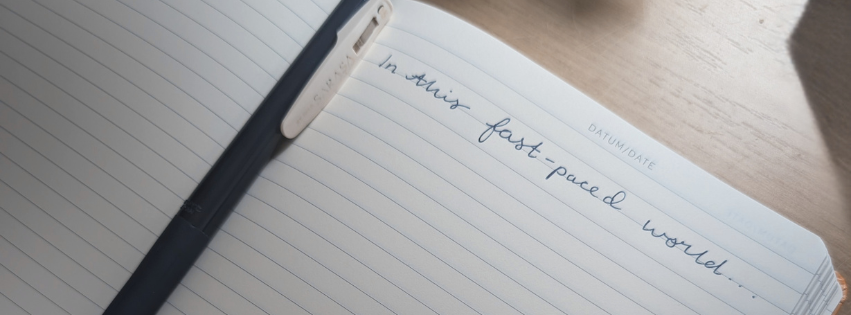
So what is it that makes us able to tell the difference? It goes further than overuse of em-dashes, or openers such as ‘in this fast paced world.’ What we’re reacting to is weirdly innate; we know it when we see/hear/feel it. It is an absence, a lack of risk. A refusal to sound like someone who is unsure or who may be wrong.
And the scary part is that, as language evolves faster, AI will learn from it faster still. It will adapt to it, and regurgitate it quickly, endlessly. We start adding in a * symbol to let people know that it is human-written? AI will learn it, adapt, and rewrite in the new style, ad infinitum. How can we compete?
Not everything has to be optimised to the point of perfection fatigue. Let your sentences jut instead of glide. Write the awkward thing, leave the stumble in. Say too much. Change your mind half way through a paragraph. Let the seams of the thing show. And please, please write it all by yourself.
I don’t write this to you as someone who has built a career around words and who is afraid of losing their job (a real issue, by the way, with demand for writers dropping by 30% since 2022) but as a human being who enjoys the art that comes out of the trials of being a human, in whatever form that may take. An algorithm can create a song in the style of Fleetwood Mac, but can it know the acute emotions that come into performing a song that your ex wrote about you, on stage night after night?
For those of us with app-addled attention spans, the TL;DR is this: AI could be a wonderful thing, when used correctly. But for creative work, write it yourself, in your own voice, and be damned with the errors. The world (literally and figuratively) will thank you for it. The future of language is in our hands.
A human was here. *