Every major shift in advertising has started quietly.
In 2000, Google Ads reshaped how brands captured intent.
In 2020, TikTok Ads redefined how attention was created and monetised.
Now, ChatGPT ads and broader AI ads are already the next chapter in online advertising.
Conversational AI is fast becoming the first place people go to research, compare and decide. Advertising is moving away from interruption and towards influence inside the decision itself.
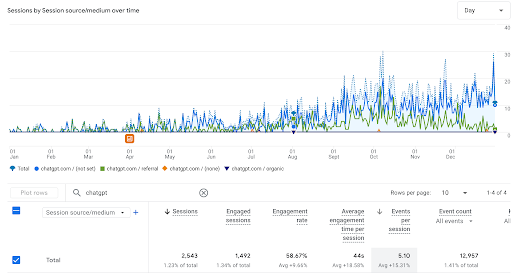
We are already seeing early signs of this shift. We’ve noticed a steady rise in referral traffic from LLM-powered sources, with traffic from ChatGPT to our site increasing by over 400% between January and December 2025; signalling that users are increasingly turning to AI for discovery rather than traditional search engines.
This represents one of the biggest opportunities for brands and advertisers to capitalise on these new lucrative channels.
AI ads; The early mover advantage.
As with any new ad platform, there’s a real opportunity for early arrivers to get cheap inventory before the rest catch up. AI advertising could provide an early, low-cost opportunity that we have seen with historic new ad platforms releases, starting with lower CPCs and cost per conversion. Early TikTok ads, for instance, averaged out £0.30-£1.50 CPC versus higher costs on established platforms earlier in the year.
Similarly, early adopters of ChatGPT ads and AI ads networks captured profitable placements at lower costs before competition increases. Agencies and brands that optimise their feeds and conversational content are positioned to benefit from first-mover advantages.
It’s not the whole story, however. For American advertising, the cheap window has been and gone. ChatGPT ads opened at a $60 CPM with a $200,000 minimum spend — enterprise-only, effectively. By 5 May the minimum had gone entirely and CPMs sat nearer $25, with CPC bidding available at $3 to $5 floors by category. Costs came down because access opened up.
And when OpenAI launched ChatGPT advertising in February, within 200 days it had already reached a billion dollars in annualised revenue run rate from the tens of thousands of advertisers who flocked to the platform. Plus, Dentsu, Omnicom, Publicis and WPP are all integrated. It’s difficult to see yourself as someone getting in early, if you arrive after four major holding companies.
The good news is that the uk window for this has only just opened…
OpenAI made ChatGPT ads purchasable directly via Ads Manager on the last day of August, for audiences in Europe, India, Northern Africa and the Middle East, adding on to a platform that was previously USA only, and included Canada from April.
For UK brands, that means a whole new channel with relatively thin competition and costs that are yet to be subject to bidding wars.
The Head of Search at Gooey Digital has this to say…
“Historically, new ad platforms have rewarded early adopters with lower costs and less competition. We will likely see the same with AI ads and ChatGPT ads showing the same early signals. Clients are already asking us about our ChatGPT ad services, so there are definitely opportunities to test these platforms.”
What AI-first advertising channels should you be considering?
Native ChatGPT ads are now a reality and brands and agencies alike should take advantage of these AI-first advertising services. So what are they?
Google AI Overview Ads
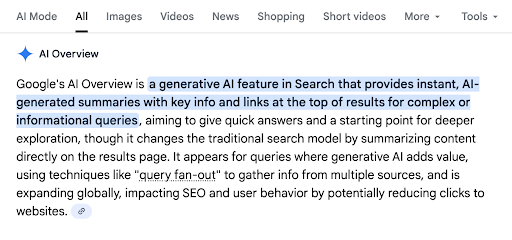
Google AI Overviews blend paid placements directly into answers. These overviews provide concise answers to questions and user queries, especially those where there’s no single “right” answer.
Ads can appear within AI Overviews when commercial intent is detected, and they are relevant to both the query and the overview content. Eligible ads come from existing Search, Shopping, and Performance Max campaigns that can win the auction and complement the information shown. According to Google internal data, users find these ads helpful because they connect directly with the products, services, or businesses they may need at that moment. It may sound like Google selling its own products, but there is the data to back up these claims.
Google’s example for this: A search for “Why is my pool green and how do I clean it?” might trigger an AI Overview suggesting water testing, debris removal, or vacuuming. Even though the query is mostly informational, Google can detect commercial intent and serve ads for pool vacuum cleaners, helping users take the next step.
For media agencies, this opens exciting opportunities. AI Overviews let advertisers reach users early in their decision journey, with ads that are contextually relevant and non-disruptive, creating a seamless path from discovery to action.
Copilot Ads
Microsoft Copilot ads represent one of the most promising AI-native advertising opportunities today. Unlike traditional search or display ads, Copilot ads are embedded directly into Microsoft productivity tools such as Word, Excel, and Teams. Meaning, users encounter ads when actively researching and in the decision-making mindset, making them highly relevant and actionable.
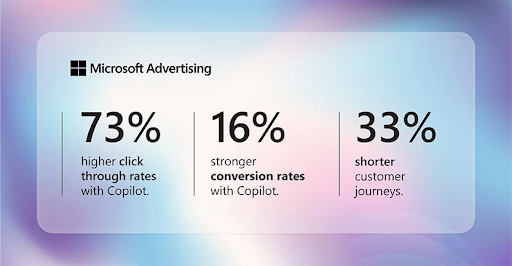
Early data and industry reports from Microsoft suggest Copilot ads deliver significantly higher click-through rates compared with standard search or display ads, while also being 30–70% more cost-efficient in some categories. For brands and agencies, this presents a chance to capture high-intent users in task-focused moments, where traditional advertising channels often struggle to reach attention.
Brand and agencies that are able to build expertise in Copilot placements early can position themselves effectively, and benefit from lower costs and higher engagement.
Workarounds for Ads Inside LLM Chats
Even before ChatGPT ads were fully commercialised, agencies were already influencing outputs through affiliate mentions, structured brand signals and AI-optimised landing experiences. This mirrors early SEO before AdWords formalised paid search.
An ever-growing source of traffic for brands is coming from direct traffic from LLMs – that is organic search queries rather than ads – , and making sure your brand is at the forefront of these LLMs ‘conversations’ is critical to capitalise on this growth.
How can you do this? By optimising your content so LLMs can easily find and understand what it is you are saying. Here’s how.
How to Get Your Brand Into ChatGPT Answers!
Paid placement and organic visibility are very separate surfaces; OpenAI is very explicit about this… ChatGPT ads run on systems separate from the model, appearing as labelled cards below the response. They also only reach free and Go tier users; Plus, Pro, Team, Business and Enterprise subscribers never see them, so it may not always be a good option for covering AI sourced traffic for all businesses.
And as AI chat tools like ChatGPT become the primary sources for discovery and decision-making, brands that appear in AI-generated answers gain a significant advantage. Agencies and in-house teams can take several steps to ensure visibility inside LLM outputs, whether they also run ads on there or not.
1. Merchant Integration and Instant Checkout
Shoppers increasingly expect frictionless experiences, and AI can now surface products with direct checkout options. Shopify and Etsy merchants, for example, can be optimised so that products appear directly in AI responses, allowing users to purchase without leaving the conversation. For brands, this means a shorter path to conversion, and for agencies, it’s an opportunity to position clients at the forefront of conversational commerce.
2. GEO and AEO Optimisation
Generative Engine Optimisation (GEO) and Answer Engine Optimisation (AEO) focus on making sure AI systems understand a brand in context. This includes:
- Reviews and reputation signals (and, increasingly, message boards such as Reddit)
- Wikipedia or credible reference mentions
By optimising these elements, agencies help brands build trust with AI systems, improving the likelihood that their content will appear in relevant LLM responses.
3. Product Feed Optimisation
AI systems ingest product data directly. Feeds that are well-structured and descriptive are more likely to be surfaced in AI outputs. Agencies can help brands:
- Clean and standardise feeds
- Add context-rich product descriptions
- Include attributes, variants, and media for AI consumption
Optimised feeds act like the new “landing pages” for AI, they enable discovery inside AI conversations.
4. Schema Markup for LLM Visibility
Schema markup is critical for AI to read and understand website content. Structured data tags for products, events, FAQs, and articles give LLMs a clear map of a brand’s content. Proper schema:
- Helps AI accurately summarise products or services
- Increases chances of appearing in conversational responses
- Functions as “AI-native SEO” for ranking in ChatGPT and other LLM results
Agencies that implement schema markup effectively are training AI to trust client content, boosting visibility and credibility inside AI-driven discovery.
Need a hand creating schema markup for a landing page? Speak to the team who can share our schema markup tools and expertise.
5. Leveraging Early Referral Signals
We are already seeing early signs of AI-driven search behaviour. Our agency has noticed a steady rise in referral traffic from LLM-powered sources, showing that users are increasingly turning to AI for discovery rather than traditional search engines. Optimising for AI visibility now positions brands to capture these high-intent interactions before the space becomes competitive.
The managing director at Gooey Digital had this to say:
“The rise in LLM referral traffic is one of the clearest signals that research behaviour is changing. As an agency and for brands, we have to evolve alongside that shift”
Forward-thinking companies aren’t waiting for AI ads or AI search to mature. They’re asking how they can show up in the user’s discovery journey today.
Adding ChatGPT Ads into your marketing strategy
Early Placement Knowledge
Agencies like Gooey already understand how brands and tools surface inside ChatGPT responses, giving them a first-mover advantage similar to early Google Ads specialists.
Know what you’re buying.
The ad unit is a highly visible, but obviously sponsored card placed below the normal response in a chat. You will be getting a title, short description, an image and a destination link. You’ll also be targeting work from a conversation rather than broad keywords, without the context of past chats. If your team is used to building keyword lists and match types, this is a fairly different exercise, and any campaign that is structured as though it isn’t could underperform.
AI-Ready Asset Libraries
Forward-thinking brands can build conversational copy and modular content ready for AI deployment, such as the format described above. Also, make sure that the landing page you are diverting them to actually answers the question a user was asking the LLM for, not the one a random keyword is trying to shoehorn them into.
AI Native Training
Teams are being trained to think about context and outcomes during the brand discovery process. That means teams that were previously building vast keyword lists now need to work towards a different model: what conversation is this person in the middle of, and what would genuinely help them next. Working as if these are paid search ads will not perform well here.
Fix the feed, your site and the schema first.
Everything that comes before this point is important whether you are trying to appear organically or in ads on an LLM platform. However, a brand that the model cannot find the information it needs from will never appear. A brand that any of the models cannot parse, won’t be recommended organically, and won’t have a coherent landing experience for paid traffic either. The work compounds; do it before the spend, not after.\
* * *
ChatGPT ads are not here to replace Google Ads overnight.
But they will go on to redefine discovery and shopping, similar to how Google Ads did in 2000 and TikTok Ads did in 2020.
Agencies that act now with an AI ads strategy, feed optimisation plans, and implemented schema markup, will capture audience attention before it becomes crowded and costly. Those that wait will compete at a premium. It’s not too late to get in on the ChatGPT ads, in the UK we are only just getting started.
Need help navigating LLM ranking and AI Ads? Speak to Nick and the team today and stay ahead of the competition.